
Guiding principles for a viable open source operational risk model
What are the guiding principles for a viable open source operational risk model (OSORM)? Such a framework should:
Our blog provides updates on important news and developments around Open Risk, and a running commentary on external developments when related to our mission. You can view posted articles either here in reverses chronological order, from the front-page or by selecting the relevant post tag from the right column.
Our archive page groups blog entries chronologically by year.
What are the guiding principles for a viable open source operational risk model (OSORM)? Such a framework should:
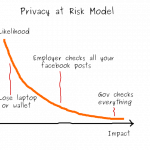
From Yahoo’s massive email data leaks, to Equifax’s exposing of sensitive data for a large segment of the US population, to Apple’s resisting the bypassing the security features of the iPhone, not a week goes by without some alarming piece of news around data privacy.
In recent decades we have been collectively spared the haunting images and existential anxiety provoked by the sight of detonating nuclear weapons for testing purposes - not to mention the increased levels of radiation in the atmosphere and other side-effects. This achievement is largely thanks to a series of treaties to control nuclear bomb testing that have been signed and enforced by most (unhappily not all) countries worldwide.

There is a legend that every time a data set is released into the open, somewhere dies a black swan
Well, it is not a true legend. Legends take centuries of oral storytelling to form. In our frantic age, dominated by the daily news cycle and viral twitter storms, legends have been replaced by the rather more short-lived memes and #hashtags.

Physics is one of those remarkably successful branches of science that have helped shape the modern era. Let your gaze drop on any man made gadget in your surroundings and its likely that its working principles go back to a fundamental discovery in physical science that dates back no more than two hundred years or so.

Ever since the scary turbulence of the Great Financial Crisis it has been instructive and illuminating to compare the travails of the financial industry with the state of other industries, especially those more down to earth, also known as real world industries.
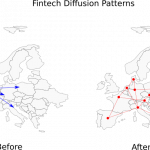
The decision by the citizens of the United Kingdom to vote against continuing membership of the European Union (#brexit) will have wide ranging repercussions on many facets of the European (and even global) economic system. As of early 2017, we see this trend further reinforced by a new US administration that aims to revisit a wide range of policy choices, including aspects of financial services regulation. While the aftershocks of these events still reverberate, it seems that we can posit quite confidently that:
Maintaining the confidence of market participants, clients, shareholders, regulators and governments is uniquely important for the financial sector. Trust is, quite literally, the real currency. Yet it is a truism that confidence is hard to build up and rather easy to destroy. Why is this so?

The Artificially Intelligent Banker is responsible for the overall management of the AI2H (AI to Human) lending department. The following requirements (job specifications) were determined by extensive data mining analysis and derived from the job description as crucial for success in the Artificially Intelligent Banker role.

A single line is sometimes the only thing that separates you from disaster!
(Update May 2017) We moved the list to the Open Risk Manual for easier editing and contributions
Accounting probably would not count among the more glamorous of professions. The reasons for that status and whether it is justified are beyond the scope of this brief commentary.
What is interesting to note, though, is that the relative attractiveness of accounting is arguably improving, driven by a number of systemic societal developments:

2017 is shaping to be the year of #regtech, aka new technology startups setting up digital shop to help the financial services sector cope with its heavy regulatory burden. But what is regulation? Why is it a burden and how does it relate to real risks and risk management?

Much has been said about the impact of Big Data and high-end GPU Computing on the provision of digital financial services. At Open Risk we wanted to explore the boundary of what is possible at the diametrically opposite end of the cost spectrum:
What is the_absolutely minimum_cost for providing digital financial services? . In this post we begin the journey of finding out the answer to that question and it promises to be fascinating!
Fintech Risk Events is an open catalog of observed and publicized operational failures of fintech business models. The catalog aims to document, in due course, such events reasonably accurately, to allow risk managers understand the ( potentially new) vulnerabilities of new financial services models.
The scope of the operational risk database is Fintech companies. By that we mean newly established financial services providers that operate exclusively via new (digital) platforms and are (mostly) unregulated. The fintech sector is distinct from established financial services firms that operate with a mix of technology platforms and are (mostly) regulated.
The current list of Top 10 Risk Manual Articles, sorted by reader popularity covers a range of topics in risk management.
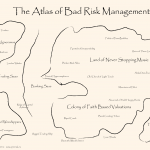
The Atlas was discovered recently in archaeological work studying pre-crisis civilizations. Despite the obvious wear and tear, all key risk failure areas have been preserved. We note the remarkable diversity of organizational forms and economic structures. Most interestingly, there is even an uncharted territory that was rumored to be inhabited by black swans.
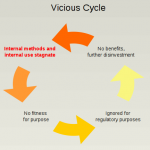
March 2016 wasn’t a good month for so-called internal risk models, the quantitative tools constructed by banks for determining such vital numbers as how much buffer capital is needed to protect the savings of their clients.

ΝΒ: This is not a post about real whales and the ongoing struggle to keep these magnificent mammals alive for future generations to marvel at. Hopefully the individuals who have risked their lives to bring the near extinction of many whale species to worldwide attention will not take offense with us usurping imagery linked to this valiant campaign. We simply want to draw attention to another, rather more armchair type of campaign, namely: saving the_AMA risk model. A bit more esoteric as a cause, but ultimately a good cause nevertheless_
This visualization from the World Bank shows the current distribution of non-performing loans (NPL’s in short) around the world, as fraction of the total outstanding loans:

Over the course of the years we have seen many an open source project that we love and use daily participate as mentoring organizations in Google’s great communal activity. This year Open Risk applied to join the effort to promote open source, in particular as it applies in the less visited area of financial risk management.